Car series

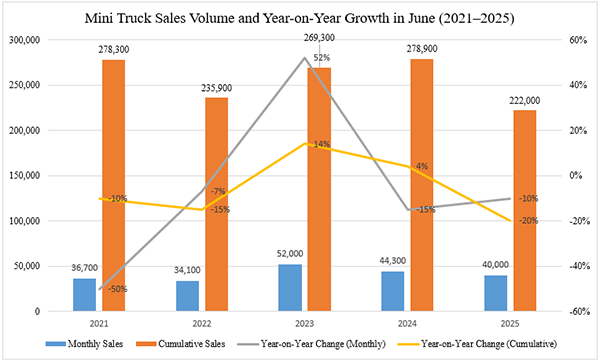
For the first half of 2025, total mini truck sales stood at 222,000 units — the lowest level for the January–June period in five years. The figure represents a drop of approximately 57,000 units compared with the same period last year.
The market saw growth in January and February, followed by four consecutive months of year-over-year declines. Sales in March, April and May dropped 28%, 31% and 34%, respectively, pushing cumulative sales through May down by 22%.
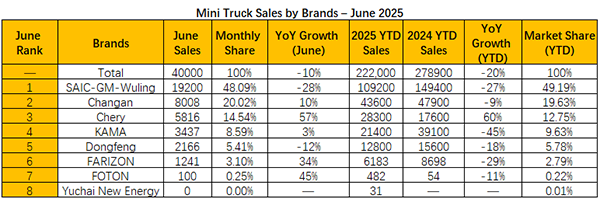
In June, the broader truck market grew 8% year-over-year, but mini truck sales fell 10% to 40,000 units, marking the fourth straight month of decline. The figure represents a 14% increase from May, but is 4,300 units fewer than in June 2024. The June result is the third highest for the month in five years, though still 12,000 units below the 2023 peak.
From January through June, total mini truck sales reached 222,000 units — the lowest first-half result in five years and 57,000 units fewer than in 2024.
Among the seven companies active in the mini truck market in June, five posted year-over-year gains. Chery led with 57% growth, followed by Foton (45%), Farizon, a Geely brand (34%), Changan (10%), and Kaima (3%). Two unnamed companies recorded double-digit declines, with one down 28%.
Wuling held the largest market share in June with approximately 19,000 units sold, representing 48.09% of the segment. Changan followed with 8,008 units (20.02%), and Chery with 5,816 units (14.54%). Kaima and Dongfeng each exceeded 2,000 units sold, while Farizon reached 1,241. Together, these six brands accounted for 99.75% of the monthly market.
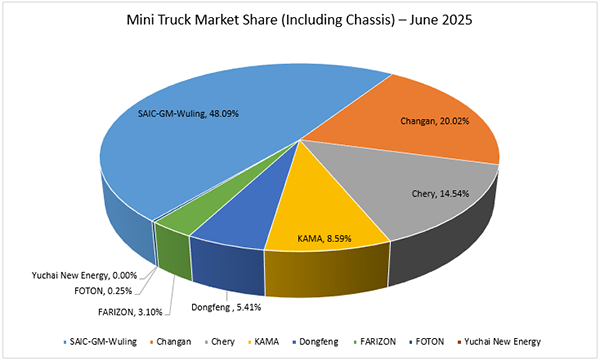
For the first half of the year, only Chery and Yuchai New Energy recorded year-over-year sales increases, with Chery up 60%. Five companies saw declines of more than 10%, with the steepest drop at 45%.
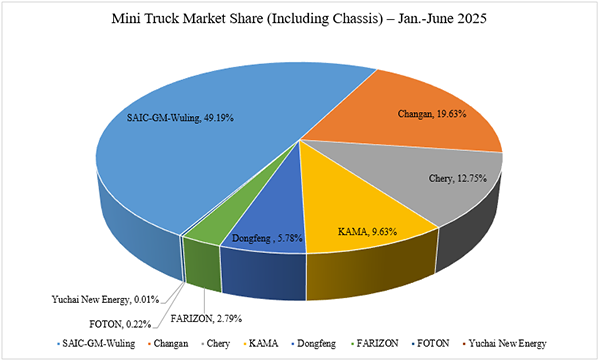
Wuling, Changan and Chery led the market in cumulative share at 49.19%, 19.63% and 12.75%, respectively. Kaima followed at 9.63%, with Dongfeng and Farizon holding 5.78% and 2.79%. All other brands remained below 0.5%.
The outlook for the remainder of 2025 remains uncertain, as the market faces rising competition and shifting demand. Returning to year-over-year growth may prove difficult, analysts say.
