Car series

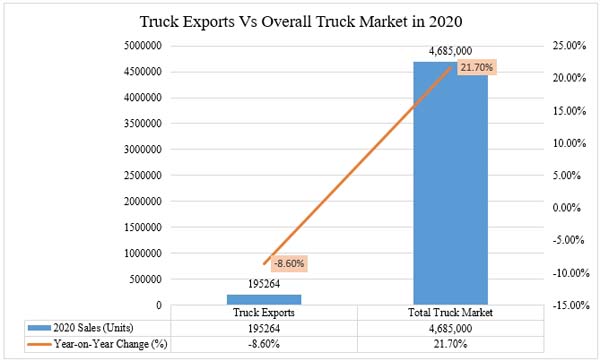

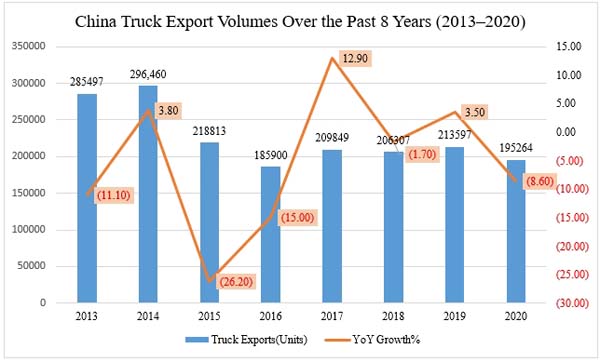
Here’s a simple look at the key trends in China’s truck exports in 2020:
1. Overall exports fell, lagging behind the domestic market
Truck exports dropped 8.6% in 2020, while the domestic truck market grew by 21.7%. Exports clearly underperformed compared with the home market.
2. Export numbers were low by recent standards
Over the past eight years, 2020 saw the second-lowest truck export volume, slightly higher than 2016. The decline shows the pandemic’s strong impact on the overseas market.
3. Truck exports fared better than overall commercial vehicles
Truck exports fell less than overall commercial vehicle exports, outperforming them by 9.4 percentage points and helping prevent a bigger drop in the commercial vehicle export market.
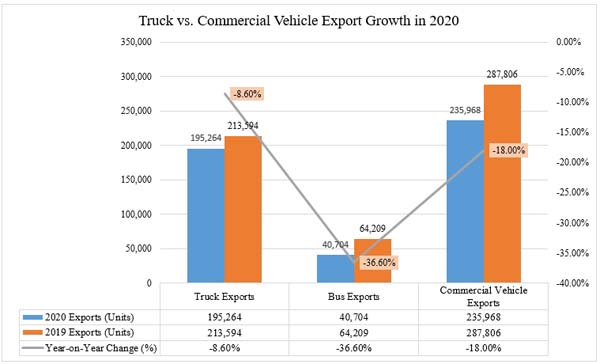
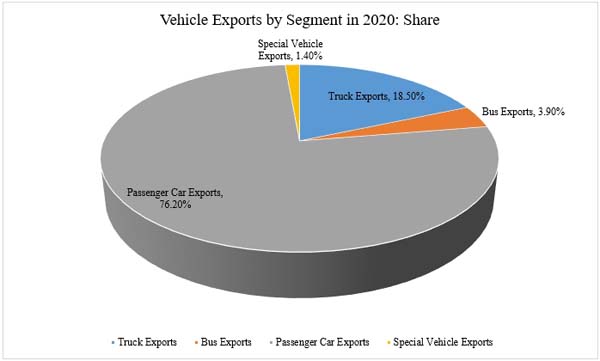
4. Trucks were the least affected among vehicle exports
Among all vehicle exports, trucks had the smallest decline, accounting for 18.5% of total vehicle exports. Key reasons:
China mainly exports trucks to developing countries in Asia, Africa, and Latin America. They are practical, affordable, and essential for construction and freight.
During the pandemic, freight demand remained strong for urgent shipments like medical supplies, whereas passenger cars saw falling demand and buses faced travel restrictions, leading to bigger drops in their exports.
5. Light trucks dominated exports
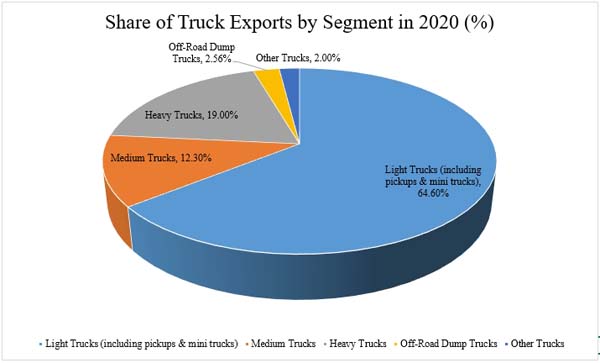
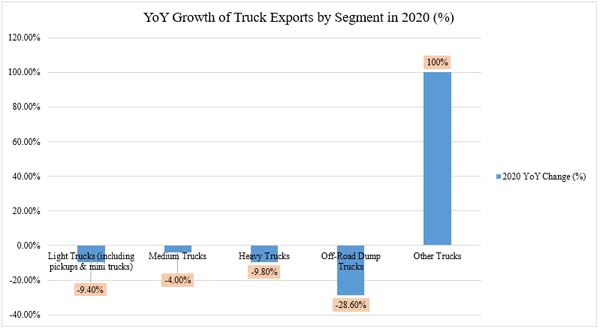
Light trucks, including pickups and mini trucks, made up 64.6% of truck exports, down 9.4% from 2019. Heavy trucks accounted for 19% (down 9.8%), medium trucks 12.3% (down 4%), and off-road dump trucks dropped the most at 28.6%.

6. Diesel trucks led exports
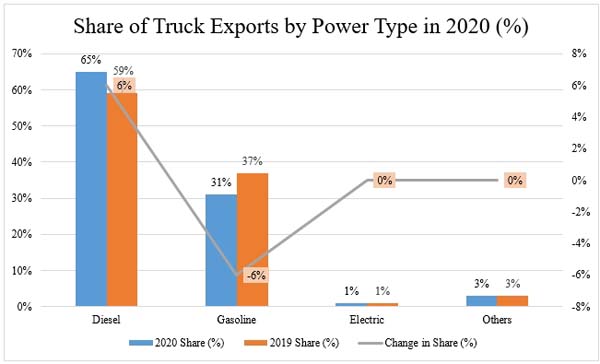
Diesel trucks represented 65% of exports, up 6 percentage points, while gasoline trucks accounted for 31%, down 6 points. Electric and other types remained small.

7. Diesel truck tonnage structure
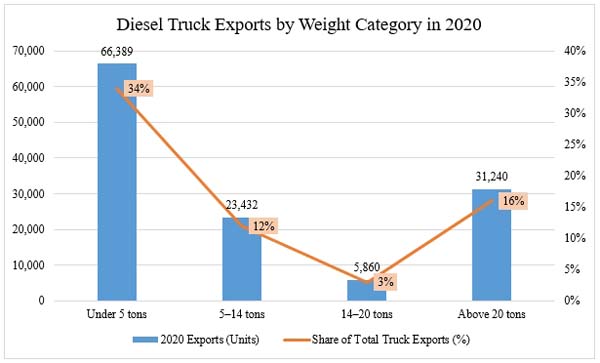
Among diesel trucks, those under 5 tons were the largest group at 34%, trucks over 20 tons made up 16%, 5–14 tons accounted for 12%, and 14–20 tons were the smallest at 3%.
8. Gasoline trucks were mainly light trucks
All gasoline trucks exported were under 5 tons, mainly mini trucks and pickups, accounting for 31% of total exports. Other sizes were nearly zero.
9. Exports concentrated in a few countries
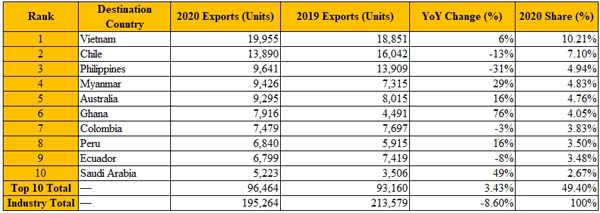
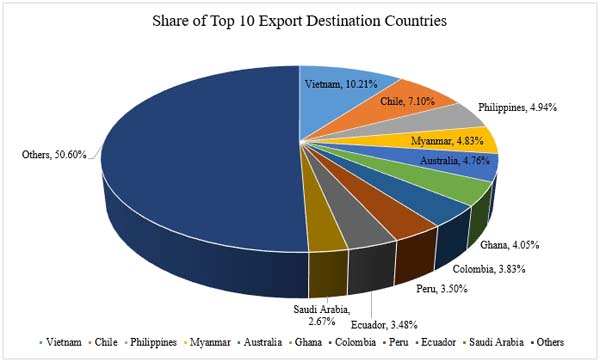
The top 10 export destinations accounted for nearly 50% of exports. Vietnam led with 10.21%, followed by Chile (7.1%) and the Philippines (4.94%). The market became more concentrated, increasing risks. Countries like South Africa, Tunisia, Algeria, and Cuba, which were major destinations before 2019, dropped out of the top 10.
How Chinese truck exporters can move forward
With the pandemic ongoing, uncertainty remains. Companies can take several steps:
Expand domestic sales: Use “internal circulation” and infrastructure projects to offset overseas losses.
Focus on overseas markets: Target Belt and Road countries and low-risk regions, maintain customer relationships.
Use cross-border e-commerce: Open new sales channels online.
Strengthen partnerships: Communicate with overseas partners to rebuild trust and confidence.
Adjust product structure: Develop medium- and high-end trucks and diversify product lines to prepare for post-pandemic recovery.
Innovate in brand promotion: Raise international awareness through global campaigns and events, like Dongfeng’s sponsorship of sailing races.
In 2020, China’s truck exports fell 8.6%, the smallest drop among vehicle categories. Light trucks and diesel models dominated exports, mainly to Asia and Latin America. Post-pandemic, companies are expected to focus on Belt and Road markets, adjust product and sales strategies, leverage e-commerce, and innovate in branding. Experts expect China’s truck export market to gradually recover in 2021.
