Car series

China’s mini truck market showed signs of recovery in July after four straight months of decline, but overall sales for the year remain under pressure.
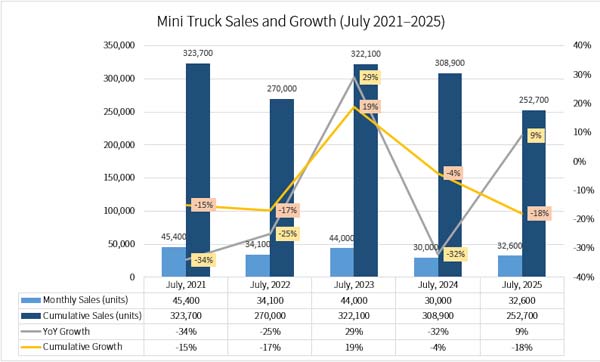
In the first half of 2025, the segment grew for two consecutive months before sliding for the next four, leaving cumulative sales down 20% by the end of June.
In July, the broader truck market sold 264,400 units — a 14% year-on-year increase but 16% lower than June. Within this, mini truck sales reached 32,600 units, up 9% year-on-year but down 18% month-on-month. It marked the segment’s first year-on-year growth since February, though its rebound lagged behind the wider truck market.
Over the past five years, July sales for mini trucks have followed a volatile “down-down-up-down-up” pattern. This July’s volume was the second-lowest in that period — nearly 13,000 units below the 2021 peak but 2,600 units higher than a year ago. From January to July, cumulative sales totaled 252,700 units, the weakest in five years and 18% lower than the same period in 2024, representing a shortfall of about 56,200 units.
Eight companies reported mini truck sales in July. Seven posted growth, led by Chery (+80%), Farizon (+34%), Dongfeng (+20%), and Foton (+27%), all of which outpaced the market average. Wuling and Changan recorded modest gains of 4% and 8%, while Yuchai New Energy added new volume. One unnamed manufacturer saw sales plunge 32%.
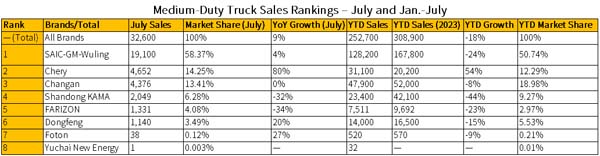
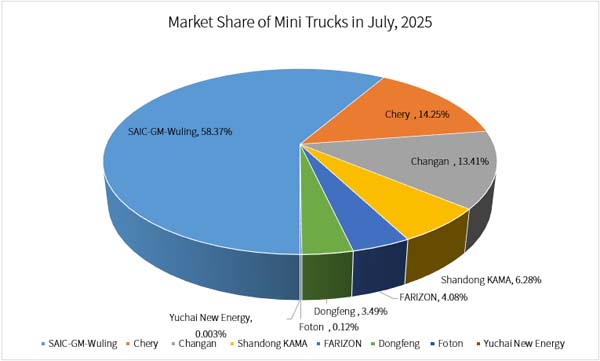
The market remains heavily concentrated. Wuling retained its dominant position with nearly 20,000 units sold, capturing 58.37% of the market. Chery ranked second with 4,652 units (14.25%), followed by Changan with 4,376 units (13.41%). Shandong KAMA secured fourth place at 6.28%, while Farizon (4.08%) and Dongfeng (3.49%) also topped 1,000 units. Together, the top six players controlled an overwhelming 99.88% of the market.
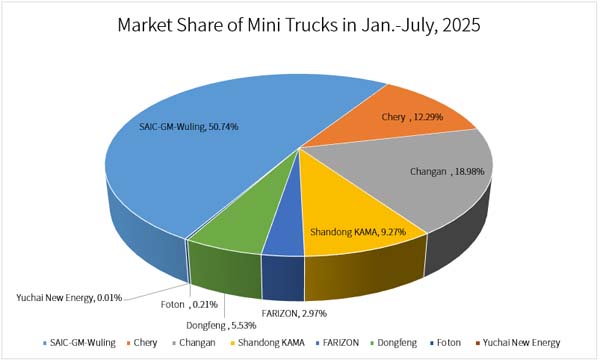
From January through July, only two companies achieved cumulative growth. Chery surged 54% year-on-year, while Yuchai New Energy added incremental sales. By contrast, six companies saw declines, including four with double-digit losses and one down 44%. In terms of market share, Wuling led with 50.74%, followed by Changan (18.98%) and Chery (12.29%). Shandong KAMA held 9.27%, with Dongfeng and Farizon at 5.53% and 2.97%, respectively. All other manufacturers accounted for less than 0.5%.
Overall, China’s mini truck market grew early in 2025 before slipping back into decline. By the end of July, cumulative sales were down 18%. With only five months left in the year, the sector faces an uphill battle to finish with positive growth.
