Car series

June Sales Edge Higher
According to compulsory traffic insurance registration data, which excludes exports and special-purpose pickup trucks, China's pickup market recorded sales of 18,928 units, up 3.53% from May but down 8.01% year on year.
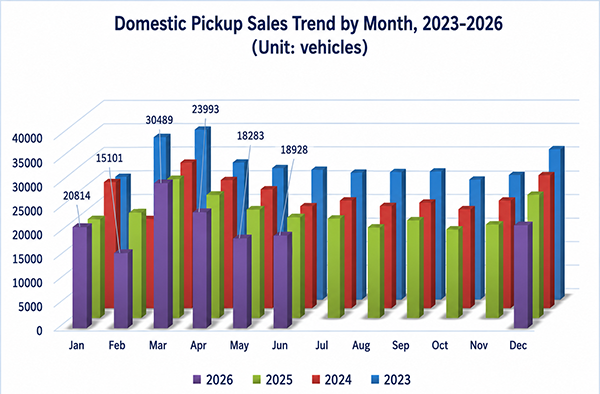
During the first half of 2026, total pickup sales reached 127,608 units, a decline of 8.15% from the same period last year. However, the pace of decline narrowed compared with the January-May period, suggesting the market is gradually stabilizing.
New Energy Pickups Continue to Outperform
Diesel pickups remained the dominant powertrain, with sales of 12,418 units in June. Sales fell 3.22% from May and 12.59% year on year.
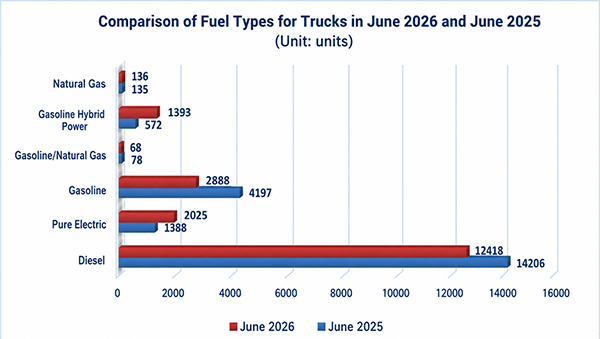
Gasoline pickups recorded sales of 2,888 units, down 2.23% month on month and 31.19% year on year. Gasoline/CNG dual-fuel models sold 68 units, declining 27.66% from May and 12.82% from a year earlier. Natural gas pickups reached 136 units, up 12.40% month on month and 0.74% year on year.
In contrast, new energy pickups continued to deliver strong growth.
Battery electric pickup sales reached 2,025 units, increasing 33.49% from May and 45.89% year on year.
Gasoline hybrid pickups recorded the strongest growth among all powertrain types. Sales surged to 1,393 units, up 81.85% month on month and 143.53% year on year.
Overall, the market continued to show a clear divide between conventional and new energy models. Demand for diesel and gasoline pickups remained under pressure, while battery electric and hybrid models gain market share. Although new energy pickups still still account for a relatively small share of the overall pickup market, their rapid growth suggests they will play an increasingly important role alongside conventional powertrains.
Radar Rises to Fourth, Chery Enters Top 10
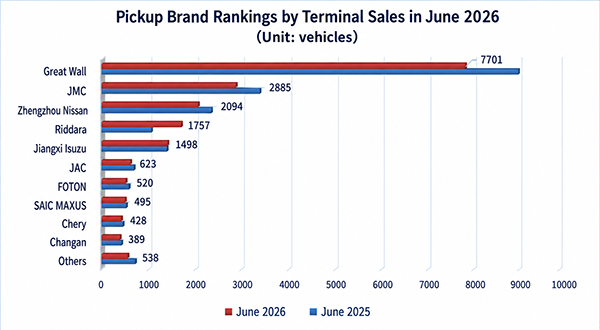
Great Wall remained the market leader in June with sales of 7,701 units, followed by JMC with 2,885 units and Zhengzhou Nissan with 2,094 units. Radar ranked fourth with 1,757 units, followed by Jiangxi Isuzu(1,498), JAC (623), Foton (520), SAIC MAXUS (495), Chery (428) and Changan (389). All other brands combined sold 538 units.
Compared with May, Radar climbed to fourth place and JAC moved up to sixth. Jiangxi Isuzu, Foton and Changan each slipped one position, while Chery entered the monthly top 10 for the first time.
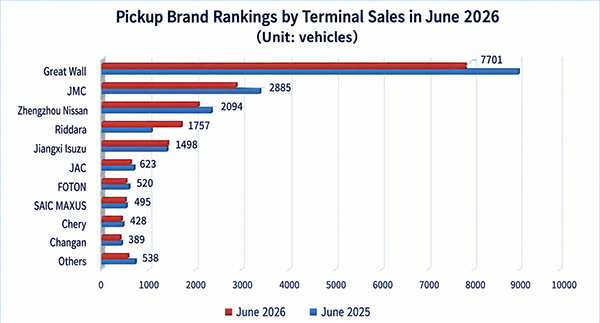
Seven of the top 10 brands reported month-on-month sales growth. Chery posted the strongest increase at 64.62%, followed by Radar at 54.26%. Zhengzhou Nissan grew 6.56%, JMC 1.05%, Jiangxi Isuzu 4.68%, JAC 9.88% and Changan 21.56%.
Meanwhile, Great Wall, Foton and SAIC MAXUS all recorded lower sales than in May, declining 4.90%, 8.93% and 10.33%, respectively.
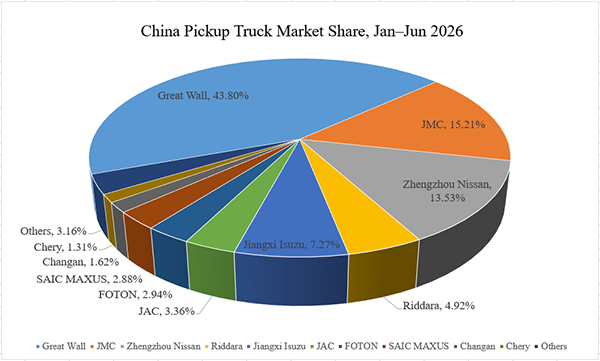
On a year-on-year basis, Radar and SAIC MAXUS recorded year-on-year growth in both June sales and year-to-date sales for the first half of 2026. Zhengzhou Nissan also recorded cumulative sales growth of 22.19%, while most other major brands continued to post year-on-year declines, highlighting ongoing market divergence.
Pickup Truck Market in June 2026 : Sales and Market Share by Brand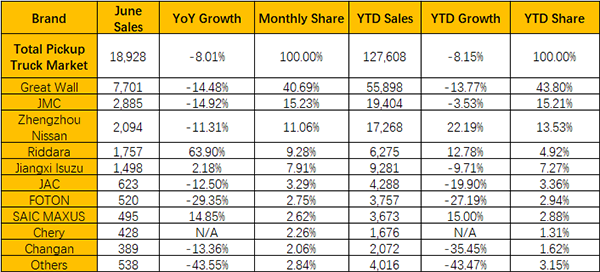
New Energy Pickup Sales Jump 74.39%
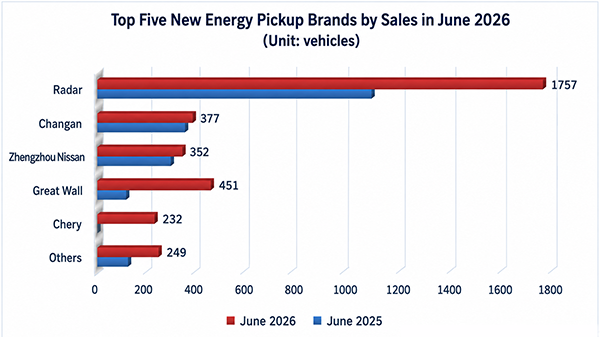
China's new energy pickup segment continued to expand rapidly in June. Sales reached 3,418 units, up 49.72% from May's 2,283 units and 74.39% higher than a year earlier.
Battery electric pickups accounted for 2,025 units, representing 59.25% of total new energy pickup sales. While still the largest segment, their share declined from 66.45% in May.
The shift reflects changing market dynamics. In May, battery electric models increased their market share as the overall market slowed. In June, however, the sharp expansion of the new energy pickup market was driven by faster growth in hybrid models, reducing the share of battery electric vehicles.
The latest figures suggest that both battery electric and hybrid technologies are contributing to market growth.
Overall, China's pickup market remained in a transition phase during the first half of 2026. Conventional fuel-powered pickups continued to face growth pressure, while new energy models emerged as an increasingly important source of demand, supported by lower operating costs and expanding use cases.
As new energy technologies continue to diversify, the pickup market is expected to evolve further. Competition is also expected to shift from sales volume toward product competitiveness, technology and market-specific applications.
